About
Founded in 2019 by Simone Harris, Walking Tall Jamaica is a cultural performance collective dedicated to preserving, celebrating, and reimagining Jamaica’s rich heritage through stilt walking, performance, and community engagement.
Rooted in the principles of culture, connection, and community, the collective serves as a dynamic platform for education, artistic exploration, and collective growth, creating immersive spaces where tradition, creativity, and social connection intersect.
2nd annual Walking Tall Jamaica Exhibition & Cultural Showcase
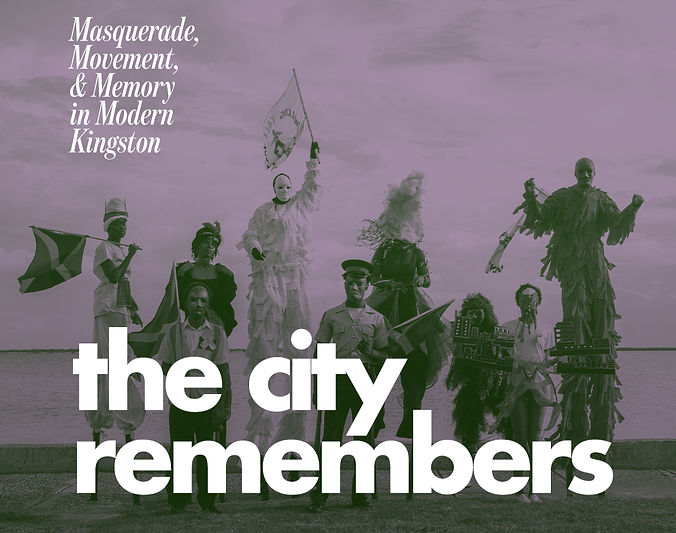
The City Remembers is a multidisciplinary performance and storytelling exhibition exploring Kingston as a living archive through Moko Jumbies and contemporary interpretations of traditional Jonkonnu masquerade characters.
The event includes:
-
Film and photography
-
Costume installation,
-
Live performances and presentations by Walking Tall Jamaica and collaborating cultural groups including Gwarra Cherry African Kumina Group, RSI Steel, the Charles Town Maroons, among others!
This year’s showcase is being presented in alignment with the 50th Annual Caribbean Studies Association Conference.


CULTURE . CONNECTION . COMMUNITY
MEET THE CHARACTERS

Simone Harris
Originating from the imagined empire of MaKroMa, a sacred world rooted in ritual, ancestral knowledge, and collective remembrance, Lady Blake arrives in Jamaica displaced across time and space after the collapse of her homeland. Moving through Kingston as both witness and archivist, she gathers fragments of memory threatened by urban expansion and modern ideas of progress. Through drum rhythms, the call of the Abeng, rum, storytelling, the cowrie and masquerade traditions, Lady Blake preserves what the city risks forgetting: ancestral truths, spiritual connection, communal histories, and ways of being grounded in collective care, resistance, and remembrance.
Photo credit: Ryan Morrison, 2026

Anansi's Grand Daughter
Johanna Taylor
Inspired by Jamaican Jonkonnu traditions, West African storytelling, and the spirit of Anansi, Anansi’s Granddaughter was created by Jo-Hanna Taylor for Walking Tall Jamaica’s Carnival in Jamaica 2025 presentation. Combining spider-like limbs, flowing fabrics, gems symbolizing transformation, and stitched Kente cloth honoring Anansi’s Ashanti roots, the character explores connection, ancestry, femininity, and resilience. Elevated on stilts, she becomes both storyteller and witness, reclaiming space for feminine power within contemporary Caribbean masquerade traditions.
Photo credit: Jik Reuben, 2025
City Skyline
Johanna Taylor
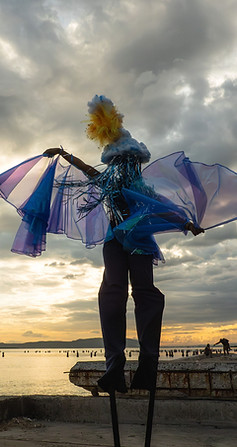
Inspired by the Kingston skyline and Jamaica’s relationship with the sea, this piece by Jo-Hanna Taylor imagines the city as both landscape and living archive. Shades of blue and shimmering winged forms reference Kingston Harbour and the Caribbean Sea, carrying histories of migration, trade, resistance, music, and survival. The cloud-like mask embedded within the skyline symbolizes the unseen spirit of the city, ancestral memories and cultural echoes suspended above the streets.
Photo credit: Gavin Gattie, 2026

House Head
Simone Harris
For The City Remembers, Simone Harris reimagines the traditional Jamaican Jonkonnu House Head character within contemporary Kingston. Replacing the colonial plantation house with modern apartment towers, the work reflects on migration, urban transformation, wealth, exclusion, and the ongoing legacy of colonial power within the city. Balanced above the stilt walker’s body, the tower becomes a symbol of aspiration and dispossession, questioning how development continues to reshape belonging, memory, and access in Kingston.
Photo credit: Gavin Gattie, 2026

Devil
Khalil Kelly
Inspired by the traditional Jamaican Jonkonnu Devil, Khalil reimagines the figure as a living cultural memory navigating the modern city. Draped entirely in red against the colonial architecture of downtown Kingston, the Devil becomes both theatrical and confrontational, reflecting the continuing struggle between good and evil, justice and corruption, spirit and survival within contemporary Jamaica. Though the traditional Jonkonnu Devil is slowly disappearing, its symbolic presence continues to haunt and shape everyday life.
Photo credit: Gavin Gattie, 2026

Warner Woman
Kathrine Johnson
Inspired by the Jamaican town crier, The Last Warner Woman is a contemporary Moko Jumbie character carrying news, warnings, memory, and oral history across generations. Positioned between folklore and contemporary reality, the figure reflects on the disappearance of communal communication in an era shaped by digital media, surveillance, and social fragmentation. Moving through the city as both prophecy and archive, she becomes a witness refusing silence in the face of cultural forgetting.
Photo credit: Gavin Gattie, 2026

Law & Disorder: Police & Security
Tajay Gordon & Ajomo Baker
Law & Disorder is a duet off stilts featuring the Police Officer and Security Guard reimagined as contemporary Jamaican Jonkonnu characters. Through masquerade, the work examines authority, surveillance, labor, and the privatization of safety within modern urban life. Positioned between spectacle and social critique, the characters reflect the contradictions of power in contemporary Jamaica, exposing how fear, inequality, visibility, and exclusion continue to shape the city while extending Jonkonnu’s tradition of satire and resistance.
Photo credit: Gavin Gattie, 2026

Morass
Breanna Jarrett
Draped in layers of greenery and performed on short stilts, Morass appears suspended between human, spirit, and landscape. Emerging from the earth itself, the figure reflects on the fragile relationship between Kingston’s expanding concrete architecture and ecological memory. Blending camouflage and masquerade, the work reimagines the Moko Jumbie as a living extension of the natural environment.
Photo credit: Gavin Gattie, 2026

The White Watcher
Simone Harris
Cloaked entirely in white and concealed behind a blank mask, White Watcher moves through Kingston as both spirit and witness, a haunting presence within a rapidly transforming cityscape. Neither fully human nor ghost, the figure embodies memory, ancestral presence, and spiritual connection. Positioned against the city’s expanding concrete architecture, White Watcher reflects on what is lost through modernization and urban development, asking what happens when cities grow disconnected from the histories and spirits beneath them.
Photo credit: Gavin Gattie, 2026
The Rolling Calf
Simone Harris
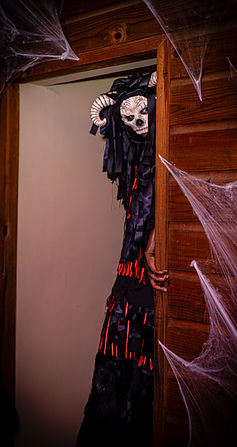
Inspired by the Jamaican folkloric figure of the Rolling Calf, a chained spirit said to haunt roads and crossroads at night, this contemporary interpretation reimagines the character within the modern city. Traditionally associated with fear, punishment, and spiritual warning, the Rolling Calf emerges through Halloween performance as both haunting presence and cultural archive. Blending folklore, horror, and theatrical spectacle, the work reflects on how Jamaican folk traditions continue to evolve while remaining deeply embedded within the cultural imagination.
Photo credit: Shadane Wright, 2024

Jamaica Jamaica
Jody Ann Brown
Created by Trinidadian artist Victoria Bisnath during the inaugural Walking Tall Kaisokah Moko Jumbie Residency in San Fernando, Trinidad, this Jamaica-inspired winged costume features layered textiles, Jamaican flags, and fabric printed with the face of Bob Marley. Activated through movement, the costume symbolizes freedom, flight, and national identity while allowing multiple Walking Tall performers to reinterpret the piece through performance.
Photo credit: Jik Reuben, 2025
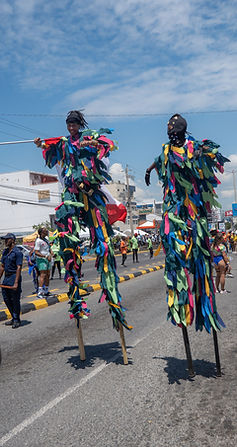
Hummingbird People
Pixel Heller & Simone Harris
The Hummingbird People is a collaborative Moko Jumbie work by Simone Harris and Pixel Heller exploring collective memory, queer identity, migration, and diasporic connection through Caribbean masquerade traditions. Moving through Kingston, the feathered figures transform the city into a site of ritual and remembrance, embodying the hummingbird’s symbolism of resilience, movement, transformation, and survival across the Caribbean diaspora.
Photo credit: Gavin Gattie, 2025
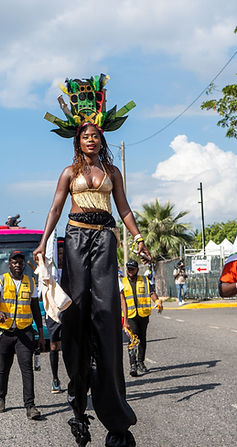
Joy in the System
Kathrine Johnson
Designed and performed by Kathrine Johnson, this contemporary Moko Jumbie features a sculptural headpiece inspired by Jamaican sound system culture. Positioned within the movement of the city, the work reflects on sound as memory, carrying stories of survival, protest, and joy, while reimagining the Moko Jumbie as a cultural guardian and living archive of Kingston’s sonic landscape.
Photo credit: Gavin Gattie, 2026

Celebrating Jamaica - New Orleans Jazz & Heritage Festival
Simone Harris & Khalil Kelly
Created for the New Orleans Jazz & Heritage Festival 2026, Jamaica and Reggae Jamaica celebrate Jamaican identity through color, masquerade, and movement. Inspired by the Jamaican flag and Rastafari symbolism, the costumes transform black, green, gold, and red into vibrant moving forms reflecting carnival, reggae, resistance, and Pan-African identity.
Together, the towering Moko Jumbies become a living tribute to Jamaica’s global cultural influence and diasporic presence.


Walking Tall: the city remembers
CURATORIAL TEAM

Simone Harris
Founder & Curator

Latoya Briscoe
Co-Curator

Gavin Gattie
Visual Archivist